Showing posts with label DMV. Show all posts

Monday, August 3, 2026

How Long Does a DMV Departmental Review Appeal Take?

 Waiting for a response from the California Department of Motor Vehicles after requesting a departmental review of an Administrative Per Se (APS) hearing can test anyone's patience.


Expected Timeline for Departmental Review Results

In California, once a request for a departmental review is submitted following an adverse APS hearing decision, it typically takes anywhere from 10-60 days to receive the written findings from the DMV Administrative Review Branch in Sacramento. In periods of heavy administrative backlog, this turnaround time can extend up to 90 days.

What Happens During the Review Period

Unlike the initial APS hearing—which is conducted locally by a Driver Safety Hearing Officer—a departmental review is handled centrally at DMV headquarters.

 Record Examination: A review officer evaluates the complete record, including transcripts, exhibits, audio recordings, and legal briefs submitted by your defense counsel.

 Scope of Review: The branch strictly reviews the record for legal errors, abuse of discretion, or procedural defects in the hearing officer’s original ruling.

 No New Evidence: The review officer does not hold a new live hearing or take new testimony.

Driving Status While Awaiting the Decision

Filing for a departmental review does not automatically stop or stay the license suspension. Unless the DMV specifically grants a stay of suspension pending the review, your license suspension goes into effect on the date specified in your initial hearing decision notice.

Potential Outcomes of the Review

 Affirmed: The original suspension order is upheld.

 Reversed / Set Aside: The decision is overturned, and driving privileges are fully restored.

 Remanded: The case is sent back to the local Driver Safety Office for a reopened hearing to correct procedural errors.

If the departmental review upholds the suspension, the remaining option is to file a Writ of Administrative Mandate in the California Superior Court within the applicable statutory deadline.


Sunday, July 26, 2026

The Video Trap at the DMV: Why Subpoenaing Body Cam Footage Can Backfire on Your Driver’s License

 By Matthew J. Ruff, Southern California DUI Defense Attorney


Top Tier DUI Attorney Matthew Ruff


When a driver faces a California Administrative Per Se (APS) hearing after a DUI arrest, the immediate instinct is often to fight fire with fire.

Many of my clients ask: "Matt, shouldn't we subpoena the police body cam and dashcam footage for the DMV hearing? It will prove the officer was lying!"

It sounds logical. In a criminal court, video footage can be a powerful tool to create reasonable doubt. But a DMV administrative hearing is a completely different legal battleground. The rules of evidence are different, the standard of proof is lower, and the person deciding your fate isn't a judge—it's a DMV hearing officer.

In over 30 years of defending drivers across Los Angeles, Torrance, and the South Bay, I have seen drivers destroy otherwise winning DMV defenses simply because they rushed to introduce police video footage.

Here is why subpoenaing body camera or dashcam video in a DMV administrative hearing isn't always prudent—and how it can severely prejudice your case (and waste your money).

1. Out-of-Pocket Expenses Fall Entirely on You

Unlike a criminal court case where state discovery laws require prosecutors to provide certain baseline evidence, the DMV does not automatically hand over police video footage for free.

To obtain body cam or dashcam footage for an administrative hearing, the burden is on the driver to formally issue and enforce subpoenas. This means you, as the client, are responsible for paying out of pocket for:

  • Government agency processing fees: Law enforcement agencies frequently charge administrative fees to locate, redact, and duplicate video files.
  • Service of process fees: Registered process servers must be hired to legally serve the subpoenas on the arresting agency or city clerk.
  • Witness and compliance fees: If an officer or custodian of records is required to authenticate the video, expert/witness mileage and appearance fees must be paid upfront.

Throwing money at video production costs before analyzing whether the footage actually helps your legal defense is a costly gamble that often yields zero return.

2. The DMV Standard of Proof Is Dangerously Low

In criminal court, the prosecutor must prove guilt beyond a reasonable doubt. At a DMV hearing, the state only needs to meet the preponderance of the evidence standard—meaning they just have to prove it is more likely than not (51%) that you were driving with a .08% BAC or higher.

  [ Criminal Court Standard ]                [ DMV Hearing Standard ]
  Beyond a Reasonable Doubt (~99%)  vs.  Preponderance of Evidence (51%)

Because the bar is so low, video footage rarely helps you the way you think it will. You might see a video that shows you walking mostly straight. But the DMV hearing officer only needs to point to a single misstep, a slight sway, or a nervous response on camera to rule that the officer had sufficient cause and that you appeared impaired. By paying out of pocket to introduce that video, you are essentially paying to hand the DMV the exact subjective visual "proof" they need to suspend your license.

3. You Might Cure a Defective Police Report

One of the most effective ways to win a DMV hearing is by exposing flaws in the official paperwork—specifically the officer's sworn statement (Form DS 367) and arrest report.

Under California law, the DMV's case relies heavily on documentary hearsay. If the arresting officer writes a vague report, omits the exact time of driving, or fails to state specific, articulable facts justifying the initial traffic stop, we can get the case set aside based on defective evidence.

The Trap: If the DMV's written paperwork is weak or missing critical facts, subpoenaing the body camera footage gives the DMV hearing officer a way to "fix" the report. The video fills in the legal gaps that would have otherwise won us the hearing.  Once the video is requested pursuant to a subpoena duces tecum the hearing officer will have access and can view the videos.  If the video was not requested the hearing officer would not have the ability to view the footage unless they request it themselves, which is rarely done.

4. DMV Hearing Officers Aren't Neutral Judges

Unlike a criminal court judge, a DMV hearing officer acts as both prosecutor and judge. They are employees of the Department of Motor Vehicles whose job is to present the state's evidence and render a ruling.

When you pay to submit a 30-minute body cam video into evidence, you are giving an administrative employee broad discretion to interpret what they see:

  • Did you sound annoyed or slur a single syllable while answering questions?
  • Did you take two seconds to locate your registration in the glovebox?
  • Did you blink repeatedly when the officer shone a flashlight in your eyes?

A defense attorney can argue that these are normal human reactions to a stressful night on the side of the road. A DMV hearing officer, however, will routinely cite those exact micro-behaviors in their written findings to justify upholding the suspension.

Strategy Beats Reflex Every Time

Does this mean we never use video at a DMV hearing? Not at all. If the written police report explicitly lies about a physical fact—such as claiming you ran a red light when video clearly proves the light was green—the footage can be a case-winning silver bullet.

However, spending your hard-earned money to request video should be a calculated legal decision, not an automatic reflex.

Before demanding dashcam or body camera files from the police, an experienced DUI attorney will analyze the DS 367 form, review the chemical test logs, and evaluate whether the written record already gives you a winning hand. In administrative law, sometimes the strongest evidence is the evidence the state failed to provide.


Saturday, January 3, 2026

Can The DMV Suspend A License When They Lack A Sworn Report (DS367)


In California, a driver may compel the 

set aside of an administrative license suspension if the DMV fails to provide a sworn statement in compliance with Vehicle Code (VC) § 13380. Under this section, an arresting officer must "immediately forward to the department a sworn report of all information relevant to the enforcement action".

The following legal arguments are typically used to contest a suspension based on this violation:
1. Violation of Mandatory Statutory Duty
Under VC § 13380, the requirement for a sworn report (typically the DS 367 form) is a mandatory duty imposed upon law enforcement.
  • The Argument: The DMV lacks jurisdiction to sustain a suspension if the foundational document—the officer's sworn statement—is missing, unsworn, or fails to contain the "grounds for belief" that the driver was in violation of DUI laws.
  • Basis for Set Aside: A "Set Aside" signifies that the Hearing Officer found no factual or legal basis for the original suspension. Without a sworn statement, there is no competent evidence to meet the DMV’s burden of proof.
2. Inadmissibility of Unsworn Evidence
While the DMV can use unsworn reports (like a standard narrative police report) to supplementor explain a sworn statement, they cannot rely solely on them if the sworn statement is fundamentally flawed or absent.
  • MacDonald v. Gutierrez (2004): The California Supreme Court held that while "technical omissions" in a sworn report can be corrected by an unsworn one, the sworn report cannot be "wholly devoid of relevant information".
  • The Argument: If the DMV provides no sworn statement, any other evidence (e.g., unsworn arrest reports) is inadmissible hearsay under Evidence Code § 1280 (the public records exception), because the specific foundational requirements of VC § 13380 have not been met.
3. Failure to Satisfy the Burden of Proof
In an Administrative Per Se (APS) hearing, the DMV must prove three specific issues: (1) the officer had reasonable cause to believe the person was driving under the influence; (2) the person was placed under lawful arrest; and (3) the person was driving with a BAC of 0.08% or higher.
  • The Argument: VC § 13380 requires the sworn report to include the officer’s "grounds for belief" and chemical test results. If this sworn statement is missing, the DMV has failed to provide "competent evidence" to support any of the three required findings

Thursday, January 23, 2025

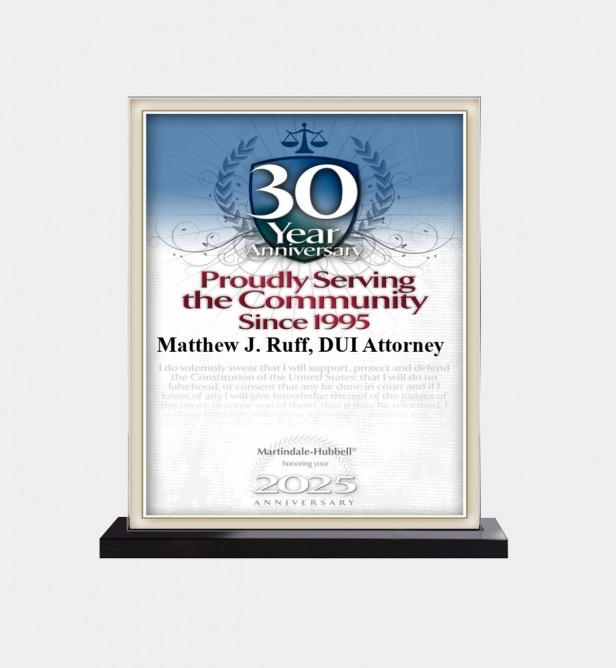
DUI Attorney Matthew Ruff Celebrates 30 Year Anniversary


Matthew J Ruff, DUI Attorney

This year Matthew celebrates 30 years defending clients charged with DUI and drunk driving in California.  

With offices located throughout California,  Torrance DUI Attorney Matthew Ruff, Long Beach, Matthew Ruff DUI Attorney, Los Angeles, San Pedro, Huntington Beach and other locations, Matthew is committed to helping people who need representation after a driving under the influence arrest.


Tuesday, February 14, 2017

What Does DMV Hearing Decision "Under Submission" Mean?

In California a DMV hearing is presided over by a state employee called a hearing officer.  This hearing officer listens to the evidence and arguments made by the attorney and decides whether the DMV has met their burden of proof with respect to a DUI arrest and whether the driver had a .08 or more or refused to take a test under state law.

After a hearing has been conducted a decision can be made immediately or can be given in writing by mail.  In many cases the hearing officer is presented with legal arguments from counsel that require him or her to review the evidence and make a final decision with regard to the case.  It is a good sign that the DMV hearing officer is taking the time to consider all of the issues.

A case taken under submission usually results in a decision being made within a few days or a couple weeks, however, during this time the person's license remains valid and they can continue to drive pending a final decision.